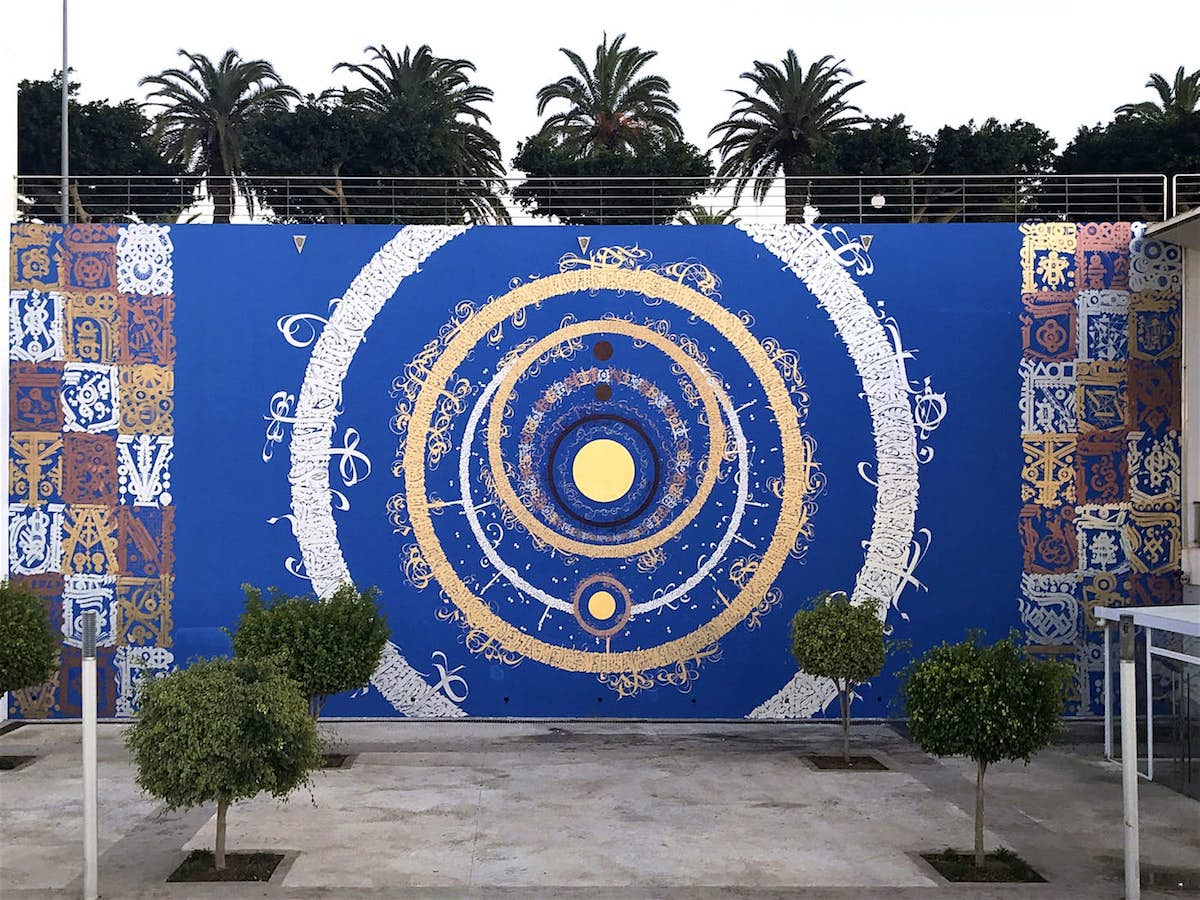
Overall, Morocco is not often known to have a particularly vibrant street art culture, as the country is often seen as relatively conservative by nature. However, the street art that does exist often highlights a connection between rich traditionalism and modernity, often incorporating traditional art on a nontraditional medium. This piece, found in Rabat, depicts the Moroccan poem ‘Dahbia’ by Annejjar in both traditional and nontraditional fashion. This mural uses calligraphy in the traditional Arabic, as well as Native American, Amazigh, and Latin calligraphy to depict the poem in a beautiful intertwining circular fashion.
This piece particularly stuck with me because of how the traditional Islamic calligraphy is used in a public space to incorporate customary languages of Morocco and unique foreign languages. I would not call this piece, or Moroccan street art in general, “official” tourist attractions.
Street art is hardly the reason that people would visit Morocco, unlike a city like Melbourne that is known for its street art and has seemingly designated tourist locations for that purpose. However, even though Morocco is mostly a land of tradition, street art can provide a certain change of pace from the traditional sites of the country. Moroccan street art seems to often connect its past to its present, allowing a unique basis for its street art themes. I have personally always found Islamic calligraphy to be particularly beautiful, and when its utilized in a public space like the piece above, it can bring a blank urban environment to life.
Further exploration of street art in Rabat (including this piece) can be found through this Lonely Planet article, as well as this Culture Trip article.
Sources: https://www.lonelyplanet.com/articles/a-diy-street-art-tour-of-rabat-the-capital-of-morocco https://theculturetrip.com/africa/morocco/articles/a-street-art-tour-of-morocco/
 Moments in Morocco